
The latest Microsoft Work Trend Index Report confirms what many of us in the technology sector have been speaking about for months, if not years – AI isn’t just an add-on; it’s the foundation for the next wave of business transformation.
The report introduces the concept of Frontier Firms – organisations that embed AI into their operations, restructuring workflows around human-agent teams rather than traditional hierarchies.
Overview of the Report
The report is clear: businesses that embrace AI now will scale faster, increase agility, and unlock productivity gains that competitors simply won’t be able to match. Companies are no longer just adopting AI as a supporting tool – they are redesigning their business models around it.
Intelligence on Tap
AI is rapidly becoming an on-demand resource, providing humans with real-time insights and automating routine tasks, enhancing productivity. AI is transitioning from a mere tool, and into a collaborative partner in the workplace.
The way that employees are using AI to enhance productivity is changing. People are integrating AI into their daily workflows, using tools like Microsoft Copilot to summarise meetings, draft emails, and organise tasks. This frees up employees to focus on the strategic and creative aspects of their work.
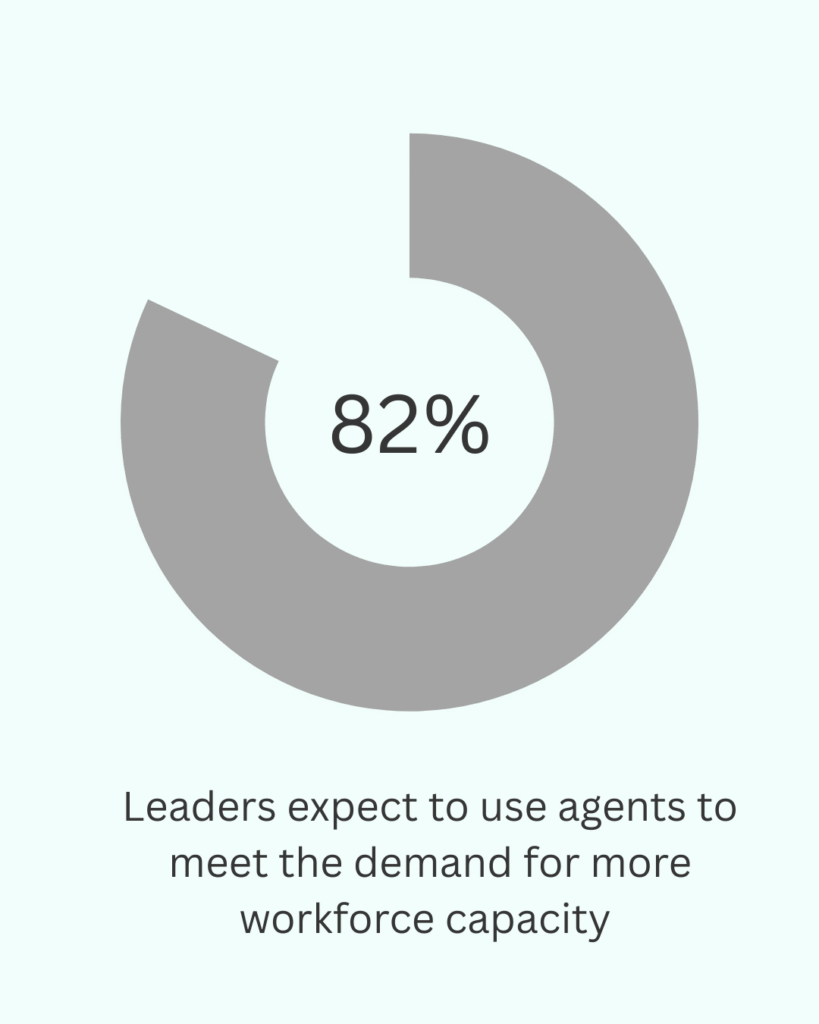
To implement Intelligence on Tap, businesses should integrate AI tools into daily workflows to automate routine tasks like summarizing meetings, drafting emails, and organizing schedules. This will free up employees to focus on higher-level, creative work.
Additionally, organisations should standardise AI tool access across teams, ensuring everyone has the support they need to leverage AI efficiently, ultimately improving overall productivity and streamlining operations.
Human-Agent Teams
The emergence of AI agents as digital colleagues marks a significant shift in team dynamics. These AI agents are not just tools but active team members capable of handling specific tasks and workflows. The report emphasizes the importance of developing AI aptitude among employees, enabling them to effectively collaborate with AI agents. Skills such as critical thinking, analytical judgment, and creativity become increasingly vital as humans and AI work in tandem to achieve organizational goals.
To foster effective human-agent collaboration, businesses should prioritize AI literacy by training employees on how to work alongside AI agents. This includes helping workers understand how to leverage AI for tasks like data analysis and creative work.
Additionally, reshaping team dynamics is crucial. AI agents should be integrated as team members, with employees using them for routine tasks and focusing on higher-level responsibilities, ensuring that AI becomes an active contributor rather than a passive tool.
The first step is to begin, start experimentation, create the sandboxes, run internal bootcamps – run bootcamps for everybody.
Karim Lakhani, Harvard Business Review
Become an Agent Boss
Looking ahead, Microsoft predicts a future where every employee becomes an “agent boss,” managing and directing AI agents to perform tasks and drive productivity. This evolution involves a three-phase transition: first, employees use AI assistants; next, AI agents join teams as digital colleagues; and finally, humans delegate entire workflows to AI agents, overseeing their performance and outcomes.
This shift empowers employees to take on leadership roles in orchestrating AI-driven processes, fostering a more agile and innovative work environment.
The agent boss: someone who builds, delegates to and manages agents to amplify their impact and take control of their career
Jared Spataro (Microsoft), The Guardian
Start by creating AI agent playbooks to guide how employees assign tasks to agents. These should clarify which workflows are safe to automate and when human oversight is still needed, helping teams build confidence and consistency in AI use.
Then, assign clear ownership for agent performance. Designate individuals or teams to review outcomes, refine prompts, and ensure agents are working effectively.
The report paints a future where business success depends on AI fluency. MSPs who recognise this shift will not only help clients evolve, but also secure their own place as critical enablers of AI transformation.
As 2025 continues to unfold, one thing is clear: MSPs must become AI architects, not just IT service providers. The winners will be the ones who adapt first.